

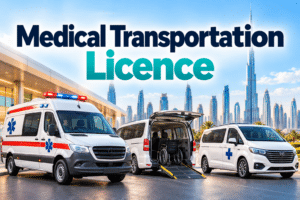
Medical Transportation Licence Cost in Dubai 2026: Complete Setup Guide
Dubai’s expanding healthcare sector, growing residential communities and demand for specialised mobility services create business opportunities for entrepreneurs interested in medical transportation.
From non-emergency patient transfers and wheelchair-accessible transportation to private ambulance services and medical logistics, the sector offers several potential business models.
However, starting a medical transportation business in Dubai in 2026 requires careful planning, the correct commercial licence, suitable vehicles and any additional transport or healthcare approvals applicable to the services provided.
If you are researching the medical transportation licence cost in Dubai, this guide explains estimated startup expenses, business activities, regulatory requirements, vehicle specifications and the company formation process.
Whether you are an international investor, healthcare entrepreneur or existing transport operator, understanding these requirements can help you plan a compliant and commercially viable business.
What Is a Medical Transportation Business in Dubai?
A medical transportation business provides transport services connected to healthcare, patient mobility or the movement of medical products.
However, not all medical transportation businesses operate under the same licence.
Common business models include:
Non-emergency patient transportation: Planned journeys for patients who do not require emergency medical intervention.
Wheelchair-accessible transportation: Transport for passengers who need accessible vehicles and mobility assistance.
Private ambulance services: Ambulance transportation involving specialised vehicles, equipment and appropriately qualified personnel.
Hospital patient transfers: Transportation between healthcare facilities, subject to the relevant service requirements.
Dialysis patient transportation: Scheduled journeys for patients travelling to and from dialysis appointments.
Medical courier services: Transportation of permitted medical documents, supplies or other healthcare-related consignments.
Laboratory specimen transportation: Movement of biological samples under applicable handling and transport rules.
Pharmaceutical transportation: Delivery of medicines and other regulated pharmaceutical products under the required distribution and storage conditions.
The licence, approvals, vehicles and staffing obligations depend on the precise activity.
Important: A general transport or logistics trade licence does not automatically authorise ambulance services, clinical patient transfers or the transport of regulated medical products.
Medical Transportation Licence Cost in Dubai 2026
The cost of setting up a medical transportation company in Dubai depends on the business activity, company structure, vehicle fleet, insurance, premises and regulatory requirements.
The following figures are illustrative business-planning estimates, not verified official 2026 government fees.
Estimated Medical Transportation Business Setup Costs
| Expense Category | Illustrative Budget |
|---|---|
| Company registration and commercial licence | AED 12,000–25,000+ |
| Office, administrative premises and initial rental expenses | AED 10,000–40,000+ |
| Suitable transport vehicle or vehicle conversion | AED 60,000–180,000+ per vehicle |
| Commercial and vehicle insurance | Depends on service and fleet |
| Vehicle registration and applicable permits | Depends on vehicle and activity |
| Healthcare or transport authority approvals | Depends on regulatory requirements |
| Driver recruitment and staffing | Depends on workforce size |
| Dispatch, GPS and booking systems | AED 3,000–15,000+ |
| Website, branding and marketing | AED 3,000–12,000+ |
| Initial working capital | Depends on operating expenses |
These estimates are intended for early budgeting only. Actual quotations may be higher or lower depending on the business model.
Ambulance operations can require significantly more investment because of specialised vehicles, clinical equipment, qualified medical personnel and additional compliance requirements.
Total Investment by Business Type
| Business Model | Illustrative Startup Investment |
|---|---|
| Small medical courier business | AED 50,000–120,000+ |
| Single-vehicle accessible transport service | AED 100,000–250,000+ |
| Small non-emergency patient transport fleet | AED 200,000–500,000+ |
| Private ambulance operation | AED 350,000–1,000,000+ |
These are hypothetical startup scenarios rather than statutory minimum capital requirements. They are not confirmed quotations for licensed ambulance or patient transport services.
Planning to start a medical transportation company? Contact Beyond View Business Services for a tailored licence and setup cost assessment.
Types of Medical Transportation Licences in Dubai
1. Non-Emergency Medical Transportation
Non-emergency medical transportation generally focuses on planned journeys for people who do not need emergency treatment during travel.
Potential customers include patients attending medical appointments, dialysis sessions or rehabilitation visits.
However, a vehicle carrying a patient is not necessarily exempt from healthcare or ambulance regulations simply because the journey is described as non-emergency.
The appropriate licence and approval pathway depends on the level of patient care, assistance, equipment and supervision involved.
2. Wheelchair-Accessible Transportation
Wheelchair-accessible transport businesses provide mobility services using appropriately adapted vehicles.
Vehicle accessibility, passenger safety, driver requirements and applicable transport permissions must be evaluated.
Where clinical patient transport or medical supervision is involved, additional healthcare-related requirements may apply.
3. Private Ambulance Services
A private ambulance service is a specialised healthcare transportation activity.
Depending on the service model, requirements may include:
Ambulance service authorisation
Approved ambulance vehicles
Medical and safety equipment
Qualified clinical personnel
Operational procedures and dispatch arrangements
Insurance and emergency protocols
Relevant inspections and regulatory approvals
Entrepreneurs should not assume that purchasing an ambulance and obtaining a commercial trade licence is sufficient to operate the service.
4. Hospital Patient Transfer Services
Patient transfers may involve movement between hospitals, clinics, diagnostic centres or other healthcare facilities.
The appropriate regulatory pathway depends on whether the service involves clinical supervision, medical equipment or regulated ambulance transportation.
5. Medical Courier and Healthcare Logistics
Medical courier businesses may transport approved healthcare supplies, documentation, equipment or other consignments.
Transporting medicines, temperature-sensitive pharmaceuticals or biological specimens can involve additional regulatory requirements.
The exact product categories and handling procedures should be confirmed before selecting the licence.
Mainland vs Free Zone: Which Is Better for Medical Transportation?
The most suitable jurisdiction depends on whether the company provides local passenger transportation, ambulance services or medical logistics.
| Factor | Dubai Mainland | Dubai Free Zone |
|---|---|---|
| Local patient transport operations | Often the more direct option to assess | Requires careful verification of permissions |
| Physical operations across Dubai | Subject to relevant transport and healthcare approvals | Additional permissions may be necessary |
| Medical logistics and distribution | Possible with appropriate activities and permits | May suit certain logistics business models |
| Ambulance operations | Require specialised authorisations | Free zone registration alone is insufficient |
| Best suited for | Local service providers and transport operators | Certain logistics, distribution or regional operations |
For a company transporting patients within Dubai, mainland business setup is generally worth evaluating first.
A free zone licence should not be assumed to provide unrestricted permission to operate passenger transport or ambulance services throughout Dubai.
Regulatory Approvals Required for Medical Transportation in Dubai
Medical transportation businesses may fall under different regulatory frameworks depending on the services provided.
Dubai Department of Economy and Tourism (DET)
DET administers relevant Dubai mainland company registration and commercial licensing procedures.
The selected activity must accurately describe the proposed operations.
Roads and Transport Authority (RTA)
RTA regulates various road transport activities in Dubai.
Depending on the service, applicable requirements may include transport activity permits, vehicle permissions and driver or operator conditions.
Not every healthcare logistics or ambulance activity follows the same RTA process.
Dubai Corporation for Ambulance Services (DCAS)
Ambulance-related activities require particular attention to the rules and approvals administered by the relevant ambulance authorities.
Operators should verify the current requirements for private ambulance services, patient transfers, vehicle specifications and clinical staffing directly with the competent authorities.
Dubai Health Authority (DHA)
DHA may be relevant where the proposed service falls within healthcare facility, professional or clinical service regulation.
The applicability of DHA licensing depends on the actual service model.
Emirates Drug Establishment (EDE)
Medical and pharmaceutical product logistics may require compliance with EDE rules concerning regulated products, establishments, importation or distribution.
The requirements differ from those applicable to passenger transportation.
The correct approval pathway must be confirmed before company registration and vehicle procurement.
Documents Required to Start a Medical Transportation Business
Documentation varies according to the business model and regulatory authority.
Commonly requested documents may include:
Passport copies of shareholders
Emirates ID and residency documents, where applicable
Proposed company name
Selected business activity
Shareholder and incorporation documents
Office or premises details
Business plan and service description
Vehicle ownership or leasing documentation
Vehicle specifications and conversion details
Insurance documentation
Driver information and relevant qualifications
Clinical staffing documents, where required
Operational and safety procedures
Additional authority-specific application forms
Ambulance operators may need more extensive technical, clinical and operational documentation.
How to Start a Medical Transportation Business in Dubai: Step-by-Step
Step 1: Choose Your Medical Transportation Business Model
Decide whether your company will provide:
Non-emergency patient transport
Wheelchair-accessible transportation
Private ambulance services
Hospital transfers
Medical courier services
Pharmaceutical or laboratory logistics
Identify exactly what passengers or products will be transported and whether medical care will be provided during the journey.
This distinction is essential for determining the appropriate licence.
Step 2: Prepare a Business Plan
Develop a financial and operational plan covering:
Startup investment
Vehicle acquisition and conversion
Licensing and approval requirements
Target customers
Staffing and driver expenses
Fuel, insurance and maintenance
Pricing and service packages
Dispatch and booking systems
Working capital
Expected revenue and cash flow
For patient transportation, consider whether the business will operate through individual bookings, scheduled journeys or contracts with healthcare providers.
Step 3: Confirm the Licensing and Regulatory Pathway
Before purchasing vehicles, consult the relevant licensing and regulatory authorities.
Determine whether the service is classified as passenger transport, clinical patient transportation, ambulance operation or medical logistics.
This step can prevent expensive changes to vehicles, staffing or company structure.
Step 4: Select the Company Structure
Choose an appropriate legal structure and evaluate mainland or free zone incorporation.
For local patient transportation, confirm whether the proposed structure allows the business to operate within Dubai under the required permissions.
Step 5: Apply for Commercial Registration
Complete the applicable trade name, company formation and initial approval procedures.
Commercial registration is only one part of the process where specialised transport or healthcare authorisations are required.
Step 6: Obtain Suitable Vehicles
Choose vehicles that meet the requirements of the proposed activity.
Depending on the service, considerations may include:
Passenger accessibility
Wheelchair restraints and safety systems
Air-conditioning and ventilation
Seating configuration
Approved medical equipment
Vehicle identification
Communication and tracking systems
Cleaning and maintenance arrangements
Do not assume that a standard van conversion will qualify as an authorised medical transport vehicle.
Step 7: Arrange Insurance and Vehicle Documentation
Obtain the appropriate insurance for the vehicles and their intended commercial use.
Confirm whether additional liability or professional insurance is required for the service model.
Step 8: Recruit Drivers and Qualified Personnel
Hire personnel according to the applicable transport and healthcare rules.
Ambulance operations may require qualified medical staff, while other services may have different driver, training and assistance requirements.
Step 9: Complete Inspections and Obtain Final Approvals
Submit the required documentation and complete any applicable inspections or technical reviews.
Begin operations only after all necessary commercial, transport and healthcare authorisations have been obtained.
Step 10: Launch Your Medical Transportation Service
Develop a marketing and partnership strategy appropriate to your approved service.
Potential channels include:
Google Search advertising
Local SEO
Hospital and clinic partnerships
Corporate healthcare contracts
Dialysis and rehabilitation centre partnerships
Online booking systems
Referral networks
Marketing must accurately describe the services the company is licensed and authorised to provide.
Best Medical Transportation Business Opportunities in Dubai
Dialysis Patient Transportation
Scheduled transport for patients attending dialysis appointments may create opportunities for recurring bookings.
Operators must verify whether the proposed service requires patient transport or ambulance-related authorisation.
Wheelchair-Accessible Transport
Accessible transport can serve customers who need suitable vehicles for routine journeys.
The business should assess passenger safety requirements, transport permissions and the distinction between mobility transport and clinical patient care.
Hospital and Clinic Transportation Contracts
Healthcare providers may require approved transport partners for permitted patient transfers or logistics services.
Contracts should clearly define responsibilities, service levels, insurance and regulatory compliance.
Medical Courier Services
Healthcare logistics businesses can explore the transport of permitted medical supplies and equipment.
Specialised products such as medicines and biological samples require careful assessment of additional handling and regulatory obligations.
Is a Medical Transportation Business Profitable in Dubai?
Profitability depends on the number of vehicles, service type, utilisation, pricing and operating expenses.
A business with recurring contracts may have a different revenue profile from an operator relying on individual bookings.
Example Revenue Calculation
Consider a hypothetical authorised transport business with:
2 vehicles
5 paid trips per vehicle per day
Average revenue of AED 150 per trip
26 operating days per month
Estimated monthly gross revenue:
2 × 5 × AED 150 × 26 = AED 39,000
This is an illustrative revenue scenario, not a market-rate forecast.
It excludes fuel, drivers, maintenance, insurance, vehicle finance, dispatch expenses, regulatory costs and other overheads.
Actual profitability will depend on utilisation and the cost structure of the approved service.
Common Mistakes to Avoid When Starting a Medical Transport Company
1. Selecting the Wrong Business Activity
Patient transportation, ambulance services and medical courier operations may have different licensing requirements.
2. Purchasing Vehicles Before Regulatory Confirmation
Vehicles may require specific equipment, layouts, certifications or approvals.
3. Underestimating Insurance and Staffing Costs
Specialised transportation can involve higher operating expenses than ordinary delivery or passenger services.
4. Assuming a Trade Licence Covers All Services
Commercial registration does not replace specialised transport or healthcare permissions.
5. Ignoring Recurring Operating Expenses
Fuel, maintenance, staff, insurance and vehicle replacement costs can significantly affect profitability.
6. Marketing Services Before Receiving Authorisation
Businesses should not advertise or provide regulated services they are not permitted to operate.
Why Choose Beyond View Business Services?
Setting up a medical transportation company involves selecting the correct business activity, understanding the applicable regulatory pathway and planning for the necessary commercial and operational requirements.
Beyond View Business Services assists entrepreneurs and investors with:
Business activity selection
Dubai mainland and free zone company formation guidance
Trade licence application assistance
Business setup cost consultation
Documentation coordination
Guidance on identifying relevant transport and healthcare authorities
Investor and residency visa assistance, where applicable
Specialised licences, permits and approvals remain subject to the requirements and decisions of the relevant authorities.
Frequently Asked Questions
1. How much does a medical transportation licence cost in Dubai in 2026?
There is no single licence price for every medical transportation activity. The total cost depends on company registration, the type of transport service, vehicle requirements and any additional regulatory approvals.
2. Can I start a non-emergency medical transportation business in Dubai?
Potentially, subject to the appropriate commercial activity and all relevant transport or healthcare approvals. The exact service model must be reviewed before applying.
3. Do I need RTA approval for medical transportation in Dubai?
RTA requirements may apply depending on the transport activity. Ambulance and clinical patient transport services may involve additional or different regulatory authorities.
4. Can I start a private ambulance company in Dubai?
Private ambulance operations are subject to specialised regulatory requirements. A trade licence alone is not sufficient to establish authorisation.
5. Can foreigners own a medical transportation company in Dubai?
Foreign investors may establish many types of companies in Dubai, subject to applicable ownership, commercial licensing and sector-specific regulations.
6. Can I operate a medical transportation company with one vehicle?
This depends on the business activity and applicable operator requirements. Some activities may have specific fleet, staffing or operational conditions.
7. Is a medical courier licence the same as an ambulance licence?
No. Medical courier services and ambulance operations are different activities with distinct regulatory considerations.
8. Can I transport medicines using a general delivery licence?
A general delivery licence should not be assumed to authorise the transport of regulated pharmaceutical products. Product-specific, distribution, storage and handling requirements may apply.
9. How long does it take to obtain a medical transportation licence?
The timeline depends on the company structure, activity classification, documentation, vehicle preparation, inspections and applicable regulatory approvals.
10. Is medical transportation a good business opportunity in Dubai?
It may be commercially viable where there is demonstrable demand, an appropriate service model and sufficient operating capital. Investors should evaluate competition, regulatory costs and potential customer contracts before committing funds.
Start Your Medical Transportation Business in Dubai with Beyond View
Planning to launch a non-emergency patient transportation company, private ambulance service, wheelchair-accessible transport business or medical logistics operation?
Beyond View Business Services can help you understand the company formation process, identify relevant licence requirements and evaluate your startup investment.