

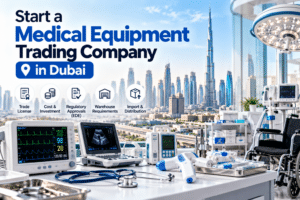
Medical Equipment Trading Company Setup in Dubai: License, Cost & Approvals 2026
Dubai and the wider UAE healthcare market create opportunities for businesses supplying medical devices, diagnostic equipment, hospital equipment and other regulated medical products. However, medical equipment trading is different from ordinary commercial trading because the establishment, products and imports can be subject to additional regulatory requirements.
For investors considering a medical equipment trading company in Dubai, the setup should therefore be planned around both commercial licensing and the regulatory pathway applicable to the products being sold.
This guide explains the licence, cost factors, approvals, medical warehouse requirements, product authorization and import considerations for setting up a medical equipment trading business in Dubai in 2026.
What Is a Medical Equipment Trading Company in Dubai?
A medical equipment trading company conducts approved commercial activities involving medical devices or equipment within the scope of its licence and applicable UAE regulations.
Depending on the approved activities and product authorizations, the business may potentially supply customers such as:
- Hospitals
- Medical centres
- Clinics
- Diagnostic centres
- Laboratories
- Dental clinics
- Healthcare groups
- Other authorized healthcare buyers
The precise regulatory requirements depend heavily on what products the company intends to import, store, distribute or market.
Medical Equipment Trading License Dubai
The first stage is identifying the correct commercial activity and legal structure for the proposed business.
The licence should accurately reflect the products and commercial activities the company intends to undertake.
For businesses importing or distributing regulated medical products, commercial licensing may be only one part of the process. The Emirates Drug Establishment (EDE) regulates relevant medical-product establishment, marketing authorization and import processes at the federal level. EDE
Medical Equipment Trading Company Setup Cost in Dubai
There is no single all-inclusive price applicable to every medical equipment company.
The total medical equipment trading company setup cost in Dubai can depend on:
- Commercial licence and business activities
- Legal structure
- Number of shareholders
- Office requirements
- Medical warehouse requirements
- EDE licensing requirements
- Inspections
- Responsible technical personnel
- Product marketing authorization
- Import requirements
- Visas and staffing
- Storage and logistics
- Insurance
- Customs-related setup
- Working capital
The product portfolio is particularly important because regulatory costs can increase when multiple medical devices require individual authorization.
Current EDE Medical Warehouse Fees
For businesses requiring an EDE-licensed medical warehouse, EDE currently lists:
| EDE Service | Published Fee |
|---|---|
| Application | AED 100 |
| Primary inspection | AED 1,000 per inspection |
| Final inspection | AED 1,000 per inspection |
| Medical warehouse licence | AED 7,500 |
| Warehouse for re-export licence | AED 10,000 |
These are EDE service fees and should not be confused with the total company setup cost. Commercial licensing, premises, staff, products, visas, fit-out and other costs can apply separately. EDE
Medical Warehouse Requirements in Dubai
A company planning to import or distribute regulated medical products may require a licensed medical warehouse, depending on its operating model.
EDE describes its medical warehouse licence as covering establishments storing and holding medical products or pharmaceutical raw materials, including warehouses used for import/distribution and warehouses used for re-export. EDE
The process can involve:
- EDE application
- Owner approval
- Primary inspection
- Initial approval
- Relevant local licensing
- Civil Defence requirements
- Appropriate professional staffing
- Final inspection
- Final establishment licensing
For a warehouse dealing exclusively with medical devices, EDE’s current procedure specifically refers to adding an equipment engineer through EDE. EDE
Medical Device Registration and Marketing Authorization
Obtaining a trading company licence does not automatically authorize every medical device for sale.
EDE provides a Marketing Authorization for a Medical Device service specifically for medical equipment intended for import and trading in the UAE. EDE states that the Marketing Authorization Holder must be registered and that the relevant marketing office or medical warehouse must hold a valid EDE licence. EDE
This is an important consideration when building your product portfolio.
Medical Device Registration Cost in UAE
EDE currently publishes the following fees for medical-device marketing authorization:
- Application fee: AED 100
- Medical device registration: AED 5,000
The published service duration is 45 working days, subject to the application meeting the applicable requirements. The resulting marketing authorization certificate is stated to be valid for five years from committee approval. EDE
These fees are separate from company licensing and medical warehouse costs.
Documents for Medical Device Marketing Authorization
Requirements vary according to the device and its classification.
EDE’s current requirements can include documentation such as:
- Application documentation
- Manufacturer registration information
- Free-sale or registration certificate from the country of origin
- Product agency agreement
- Quality/conformity documentation
- Device classification information
- Product description
- Models and accessories
- Intended uses
- Warnings and precautions
- Packaging information
- Product brochures/manuals
- Declaration of conformity
- Safety and efficacy information for applicable higher-risk classifications
Additional requirements can apply depending on the device. EDE
Medical Device Classification Matters
Medical equipment is not one homogeneous product category.
EDE’s current marketing-authorization documentation refers to medical-device classifications Class I, II, III and IV, with requirements varying according to classification. Higher-risk devices can require additional safety and efficacy documentation. EDE
This is why an entrepreneur should define the exact product list before requesting a complete setup quotation.
Medical Equipment Import Requirements in Dubai
Businesses importing medical equipment need to consider import authorization in addition to company and product licensing.
EDE’s current import-permit service covers medical equipment and other regulated medical products. For medical equipment, its stated conditions include obtaining the applicable product marketing authorization and having importation carried out by the local agent identified in that authorization. EDE
Shipment and customs documentation can also be required.
Medical Equipment Import Permit Cost
EDE currently lists an AED 100 application fee for its medical items and products import-permit service. Other fees or regulatory requirements may apply depending on the product category and circumstances. EDE
Do not interpret this AED 100 application fee as the total cost of importing medical equipment.
Freight, customs, warehousing, insurance, clearance and other commercial expenses may also apply.
Medical Equipment Trading Setup Process in Dubai
The precise pathway depends on the proposed products and business structure, but the planning process generally follows these stages.
1. Define Your Medical Equipment
Prepare a detailed product list before forming the company.
Identify:
- Product name
- Manufacturer
- Country of origin
- Intended use
- Device classification where known
- Whether products are already authorized in the UAE
- Proposed import/distribution arrangement
This step can prevent expensive restructuring later.
2. Select the Correct Business Activity
Choose the commercial activity that accurately represents the intended trading operation.
Avoid selecting a generic activity purely because it is inexpensive.
3. Choose the Appropriate Company Structure
Determine the legal structure and licensing jurisdiction based on ownership, customers, import arrangements and operational requirements.
4. Complete Commercial Licensing Requirements
Proceed with trade-name and company-formation requirements through the appropriate Dubai licensing channel.
5. Arrange Appropriate Premises
Determine whether the operation requires an office, warehouse or other approved premises.
For regulated medical-product warehousing, the facility must satisfy the applicable EDE and related requirements. EDE
6. Complete Regulatory Establishment Licensing
Where applicable, obtain the required EDE establishment approvals and complete the relevant inspections.
7. Complete Medical Device Authorization
Determine whether each product requires EDE marketing authorization and prepare the applicable registration documentation.
8. Arrange Import Authorization
If importing products, complete the relevant import-permit and shipment-clearance procedures before bringing regulated products into the UAE market. EDE
9. Begin Distribution
Once all requirements applicable to the establishment and products have been completed, the business can proceed with authorized commercial operations.
Documents Required for Company Formation
Commercial company-formation requirements depend on the legal structure and shareholders.
Typical documentation can include:
- Passport copies
- Identification documents where applicable
- Shareholder information
- Proposed company names
- Business activity details
- Application documents
- Corporate documents for corporate shareholders
- Premises documentation where required
Regulatory establishment and product authorization require separate documentation beyond basic company formation.
Mainland vs Free Zone for Medical Equipment Trading
This decision should be based on the complete operating model rather than the cheapest licence offer.
Dubai Mainland
A mainland structure may suit businesses targeting hospitals, clinics and healthcare customers directly within Dubai and the UAE, subject to applicable licensing and regulatory requirements.
Free Zone
A free-zone structure can be considered for certain import, export, re-export or regional distribution models.
However, the movement and distribution of regulated medical products into the UAE market can involve additional requirements.
Before choosing, evaluate:
- Customer location
- Import model
- Distribution strategy
- Warehouse requirements
- EDE requirements
- Customs arrangements
- Product authorization
- Re-export plans
Medical Equipment Trading vs Medical Supplies Trading
The terms are sometimes used interchangeably in everyday business discussions, but the regulatory treatment of individual products can differ.
A sophisticated diagnostic device is not necessarily treated the same way as a simpler healthcare supply.
Before adding products to the company’s portfolio, determine their classification and applicable regulatory pathway.
Medical Equipment vs Pharmaceutical Trading
Medical equipment and pharmaceutical products are not identical regulatory categories.
If the company intends to sell medicines, pharmaceuticals or other specialized healthcare products in addition to medical devices, additional or different requirements can apply.
The licence and regulatory structure should therefore be built around the actual products.
Medical Equipment Storage Requirements
Medical products should be stored under conditions appropriate to their specifications and applicable requirements.
Depending on the equipment, warehouse planning may need to consider:
- Temperature
- Humidity
- Cleanliness
- Product segregation
- Inventory control
- Receiving and dispatch procedures
- Security
- Traceability
- Manufacturer instructions
- Applicable good-storage requirements
Avoid leasing or fitting out a warehouse before confirming the requirements applicable to your planned product portfolio.
Can Foreign Investors Start a Medical Equipment Company in Dubai?
Foreign investors can establish businesses subject to the ownership rules applicable to the chosen activity and structure.
EDE’s medical warehouse licensing information states that non-UAE nationals may own a pharmaceutical entity where approval is obtained from the relevant local authority specifying the permitted foreign ownership percentage. EDE
The exact ownership structure should therefore be confirmed for the proposed business.
Who Can a Medical Equipment Trading Company Supply?
Depending on its approved activities, product authorizations and regulatory permissions, potential B2B markets can include:
- Hospitals
- Clinics
- Medical centres
- Diagnostic laboratories
- Dental centres
- Healthcare groups
- Rehabilitation facilities
- Other authorized medical-sector customers
Before approaching buyers, ensure the company and relevant products have the permissions required for the proposed transaction.
Medical Equipment Business Opportunities in Dubai
Rather than attempting to trade every type of medical device, new companies can consider specializing in a defined segment.
Potential areas can include:
Diagnostic Equipment
Products used by hospitals, clinics and diagnostic centres.
Dental Equipment
Equipment and devices serving dental clinics and specialist centres.
Laboratory Equipment
Products used in clinical and diagnostic laboratory environments.
Hospital Equipment
Equipment supporting healthcare facilities and patient care.
Rehabilitation Equipment
Products used in rehabilitation and appropriate healthcare environments.
The exact regulatory treatment should be checked product by product.
How Much Investment Is Needed?
The total investment extends well beyond the commercial licence.
A realistic financial model can include:
Company Setup + Regulatory Licensing + Premises + Product Authorization + Inventory + Import + Logistics + Staff + Marketing + Working Capital
For an importer or distributor, inventory and receivables can represent significant capital requirements.
Ongoing Costs to Consider
After launch, recurring expenses can include:
- Commercial licence renewal
- Regulatory establishment renewal
- Premises rent
- Staff costs
- Product authorization/renewal
- Warehouse operations
- Inventory
- Freight
- Customs-related expenses
- Insurance
- Marketing
- Accounting
- Tax compliance
- Equipment servicing
- Transportation
Separate initial setup expenses from recurring operating costs when preparing the business plan.
Marketing Medical Products in the UAE
Medical-product promotion is also regulated.
EDE provides a specific service for licensing advertisements for medical products across formats including print, audio, video, social media and websites. Its current conditions include having valid marketing authorization for products that require it and ensuring advertising is truthful, non-misleading and supported by evidence. EDE
This matters for companies planning Google Ads, social media campaigns or other product promotions.
Common Mistakes When Starting a Medical Equipment Trading Company
Treating It Like Ordinary Trading
Medical devices can have establishment, product and import requirements beyond a standard commercial licence.
Choosing the Licence Before Defining Products
The product portfolio can materially affect the required regulatory structure.
Importing Before Completing Product Requirements
Do not place major international orders without confirming authorization and import requirements.
Renting a Warehouse Too Early
Confirm regulatory specifications before committing to premises and fit-out.
Ignoring Device Classification
Classification can affect documentation and authorization requirements.
Underestimating Registration Costs
If numerous products require separate authorizations, regulatory costs should be incorporated into the investment plan.
Making Unverified Medical Claims
Marketing claims for medical products should align with authorized product information and applicable advertising requirements.
How to Reduce Setup Delays
A well-prepared application begins with the product portfolio.
Before starting, prepare:
- Manufacturer details
- Product list
- Device classifications
- Country-of-origin documentation
- Existing regulatory certificates
- Distribution agreements
- Intended UAE customers
- Import strategy
- Warehouse requirements
Identifying missing documentation before filing can reduce avoidable back-and-forth.
How to Get an Accurate Medical Equipment Trading Setup Quote
To obtain a meaningful quotation, provide:
- Medical devices you intend to trade
- Number of products/models
- Manufacturer details
- Countries of origin
- UAE authorization status
- Number of shareholders
- Import/export plans
- Warehouse requirements
- Number of employees
- Visa requirements
- Target customers
A quotation should distinguish between commercial company formation costs, regulatory establishment costs, product authorization fees and operational expenses.
Start a Medical Equipment Trading Company in Dubai
Setting up a medical equipment trading company in Dubai can provide access to a substantial healthcare market, but success depends on getting the regulatory structure right from the beginning.
The project may involve commercial licensing, an appropriate medical establishment, product marketing authorization and import permissions depending on the business model and products.
Before signing a warehouse lease or ordering medical devices from overseas, establish the regulatory pathway for each product category.
Planning to start a medical equipment trading company in Dubai? Request a customized setup assessment based on your products, import model, warehouse requirements and target market.
Frequently Asked Questions
How much does a medical equipment trading company cost in Dubai?
There is no single all-inclusive amount. Costs can include commercial licensing, premises, regulatory establishment licensing, inspections, product authorization, staffing, visas, warehousing and import-related expenses.
What is the primary SEO keyword for this page?
medical equipment trading company Dubai
A strong secondary keyword is medical equipment trading license Dubai.
Does a Dubai trade licence alone allow me to import medical devices?
Not necessarily. Regulated medical equipment can require EDE establishment, product marketing authorization and import-permit requirements in addition to commercial licensing. EDE
How much does EDE medical-device registration cost?
EDE currently lists an AED 100 application fee and AED 5,000 medical-device registration fee for its marketing-authorization service. EDE
How much does an EDE medical warehouse licence cost?
EDE currently lists AED 100 for the application, AED 1,000 per primary inspection, AED 1,000 per final inspection and AED 7,500 for the final medical warehouse licence. EDE
How long does medical-device marketing authorization take?
EDE currently lists a service completion duration of 45 working days for medical-device marketing authorization. This should not be presented as a guaranteed total company-setup timeline. EDE
Can I import medical equipment from overseas?
Yes, subject to the applicable establishment, product, agency, import and customs requirements. EDE maintains a dedicated import-permit process for regulated medical equipment. EDE
Do medical devices need to be registered individually?
Product authorization requirements depend on the device and regulatory classification. Determine the applicable requirements for each product/model before importing or marketing it.
Can I advertise medical equipment online?
Medical-product advertising can require EDE approval. EDE’s current service covers channels including websites and social media, with conditions concerning valid product authorization and truthful, evidence-supported advertising. EDE
Should I choose Dubai mainland or a free zone?
It depends on where you will sell, how products will be imported/distributed, warehouse requirements and your re-export strategy. For a regulated medical-device business, compare the entire regulatory and distribution structure rather than the commercial licence price alone.